beehiiv vs Maito 2026: Growth Suite or Social-to-Newsletter Workflow?
A side-by-side decision guide for creators choosing between beehiiv's mature growth stack and Maito's X/LinkedIn-to-subscriber workflow.
beehiiv and Maito both help creators build newsletters, but they are built around different operating models. Choose beehiiv if you want a mature newsletter growth suite with referrals, recommendations, ads, Boosts, automations, and monetization depth. Choose Maito if your newsletter is the home base and X/LinkedIn are the growth channels you use to turn social attention into attributed subscribers.
This comparison focuses on the decision between beehiiv and Maito. For a deeper beehiiv-only breakdown, read our full beehiiv review.
Pricing and feature details were last checked on May 30, 2026 against beehiiv's official pricing page and feature pages.
Quick answer#
Use beehiiv if you want the broadest newsletter-growth and monetization platform in one hosted product. It is stronger for operators who need referrals, recommendations, an ad network, Boosts, paid subscriptions, automations, surveys, advanced analytics, and a serious publication-growth toolkit.
Use Maito if you publish a newsletter and use X or LinkedIn to grow it. Maito helps you write and publish newsletter issues, promote them with native X and LinkedIn posts, add tracked newsletter links, see which posts create subscribers, and segment readers by source or behavior. It also gives you hosted sites, custom domains, widgets, API/MCP access, and coding-agent prompts for custom builds.
beehiiv vs Maito at a glance#
| Category | beehiiv | Maito |
|---|---|---|
| Best for | Newsletter operators who want mature growth and monetization tooling | Creators who grow through X/LinkedIn and want those posts to feed an owned newsletter |
| Core position | Newsletter growth platform | Newsletter-first social growth workspace |
| Newsletter publishing | Strong issue publishing, website, and newsletter operating tools | Full newsletter issues, hosted site, archive, custom domain, and subscribe paths |
| Website/archive | Strong for publication-style newsletter sites | Hosted newsletter site, public archive, issue pages, widgets, and API for custom builds |
| Social publishing | Not the center of the workflow | Native X and LinkedIn editors, previews, scheduling, and newsletter-link promotion |
| Subscriber attribution from social | Not the main product promise | Built around tracking which social posts and links create subscribers |
| API, MCP, and agent workflows | API access and beehiiv MCP are listed on the pricing page; not centered on social-to-subscriber attribution | Open API and MCP surfaces for newsletter operations, custom sites, subscriber data, attribution, and agent workflows |
| Growth tools | Referrals, recommendations, Boosts, forms, pop-ups, magic links | Social-to-newsletter CTAs, source attribution, segmentation, and subscriber filtering |
| Monetization | Strong: Ad Network, paid subscriptions, Boosts, sponsorships, digital products | Not the main differentiation today; stronger for audience ownership and social conversion |
| Automations | Strong on paid plans | Scheduling, attribution, segmentation, API, and MCP workflows; less mature as a marketing automation suite |
| Analytics | Strong newsletter analytics and segmentation | Source attribution analytics focused on subscriber origin, social posts, and reader groups |
| Pricing model | Free Launch plan; paid plans unlock growth/monetization depth | Free Hobby plan up to 1,000 active subscribers; Scale starts at $29/month for 2,500 subscribers |
| Main tradeoff | Powerful but can feel heavy or expensive if you do not need the full suite | More focused, but not as deep as beehiiv for referrals, ads, and monetization machinery |

Choose beehiiv if#
Choose beehiiv if your goal is to operate a newsletter like a media business.
beehiiv is the better choice when you want:
- a mature newsletter-growth platform
- referrals and recommendations
- Boosts and an ad network
- paid subscriptions with 0% platform take rate
- direct sponsorship and digital product tools
- automations, surveys, polls, analytics, and segmentation
- a broader all-in-one newsletter business stack

This is where beehiiv deserves credit. Its feature pages show a deep toolkit for growth, monetization, analytics, and publishing. If the newsletter is already becoming a business and you expect to use those features, beehiiv is hard to dismiss.
Choose Maito if#
Choose Maito if your newsletter grows from social attention.
Maito is designed for creators who publish ideas, essays, launches, or issue teasers on X and LinkedIn, then want those posts to bring people back to an owned newsletter instead of leaving the relationship inside the feed.
Maito is the better choice when you want:
- the newsletter to be the home base
- native X and LinkedIn editors
- native X and LinkedIn previews before publishing
- scheduled newsletter issues and scheduled social promotion
- automatic newsletter links inside social posts
- subscriber attribution from specific posts and links
- segments based on source, behavior, and subscriber activity
- hosted newsletter sites, custom domains, widgets, API, and MCP access
- the ability to build custom newsletter sites, archives, subscribe experiences, and internal workflows on top of Maito's API
- AI-assisted workflows for connecting Maito into your own site or operating process
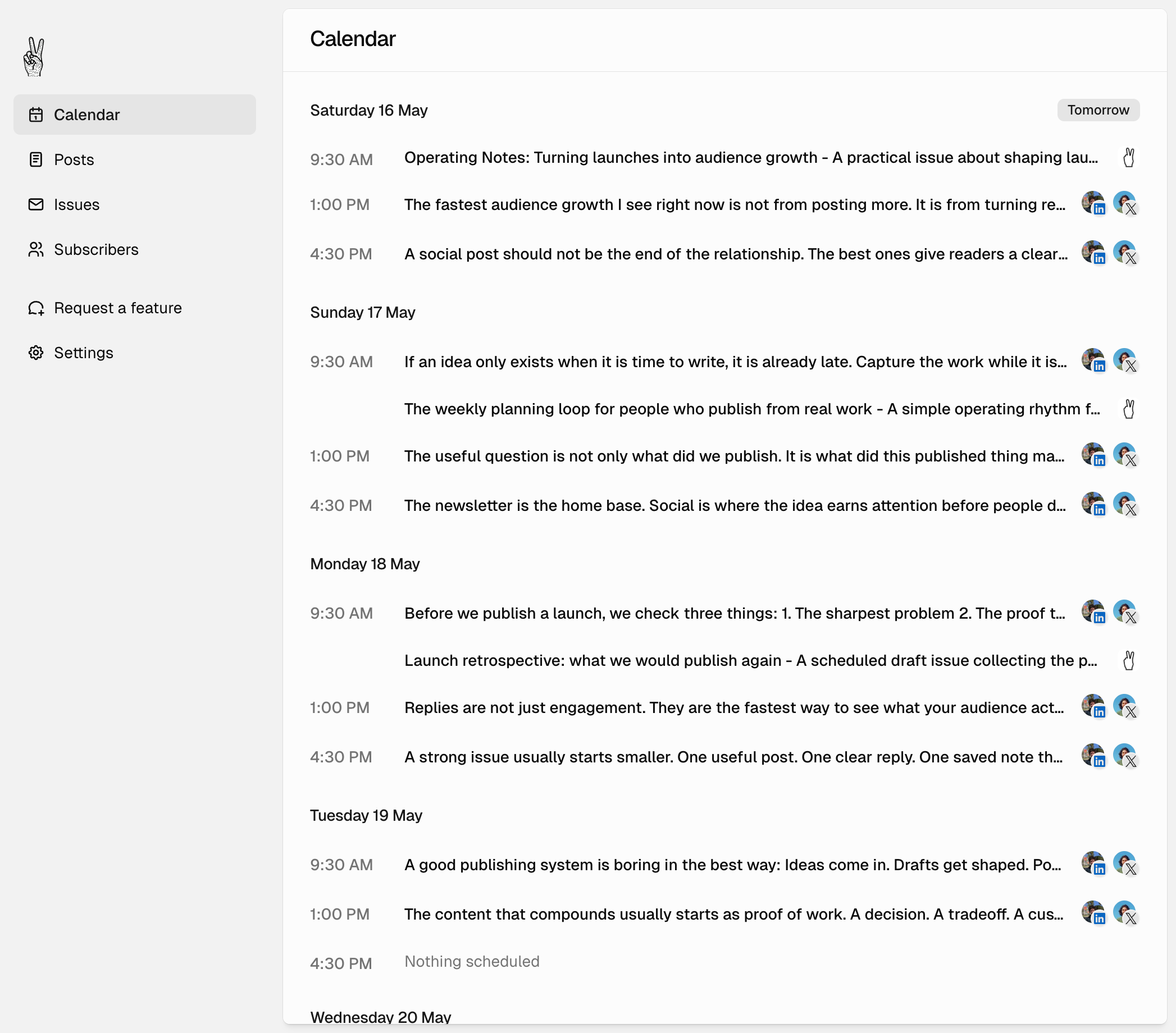
The difference is not "newsletter vs social." The difference is that Maito treats social as the growth layer for the newsletter. The post creates attention. The newsletter captures the relationship.
Newsletter publishing comparison#
beehiiv is stronger if you want a full newsletter-growth suite. Maito is stronger if you want a focused workflow where issue publishing, social promotion, attribution, and subscriber management stay close together.
| Workflow | beehiiv | Maito |
|---|---|---|
| Write and publish newsletter issues | Strong | Strong |
| Publish a public archive | Strong | Strong |
| Manage subscribers | Strong | Strong |
| Import/export subscribers | Supported | Supported |
| Build a media-style publication | Stronger | Good, but lighter |
| Publish and promote from the same calendar | Not the main workflow | Core workflow |
| Use social posts as subscriber acquisition paths | Possible, but not the center | Core workflow |
If your main question is "Which tool has more newsletter growth machinery?" beehiiv wins.
If your main question is "Which tool helps me publish the issue and turn X/LinkedIn attention into subscribers?" Maito is the sharper fit.
Social growth and subscriber attribution#
This is the biggest difference between the two products.
beehiiv gives newsletter operators serious audience tools. But beehiiv is not primarily positioned around native X/LinkedIn drafting, previewing, scheduling, and post-level subscriber attribution.
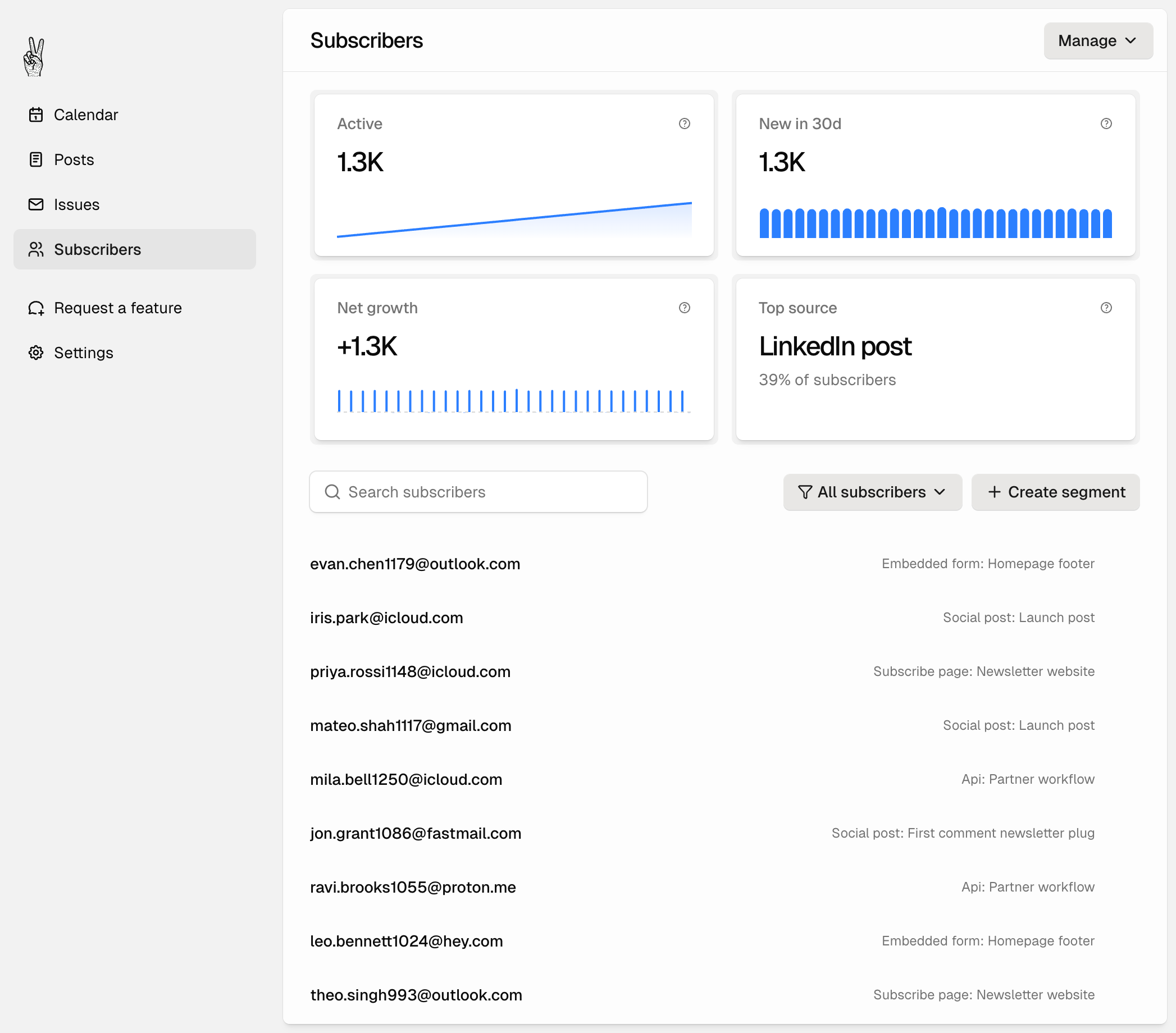
Maito's social publishing workflow is built around that job. You can write channel-specific social posts, preview them, schedule them, attach a newsletter link, and later see which post created a subscriber.
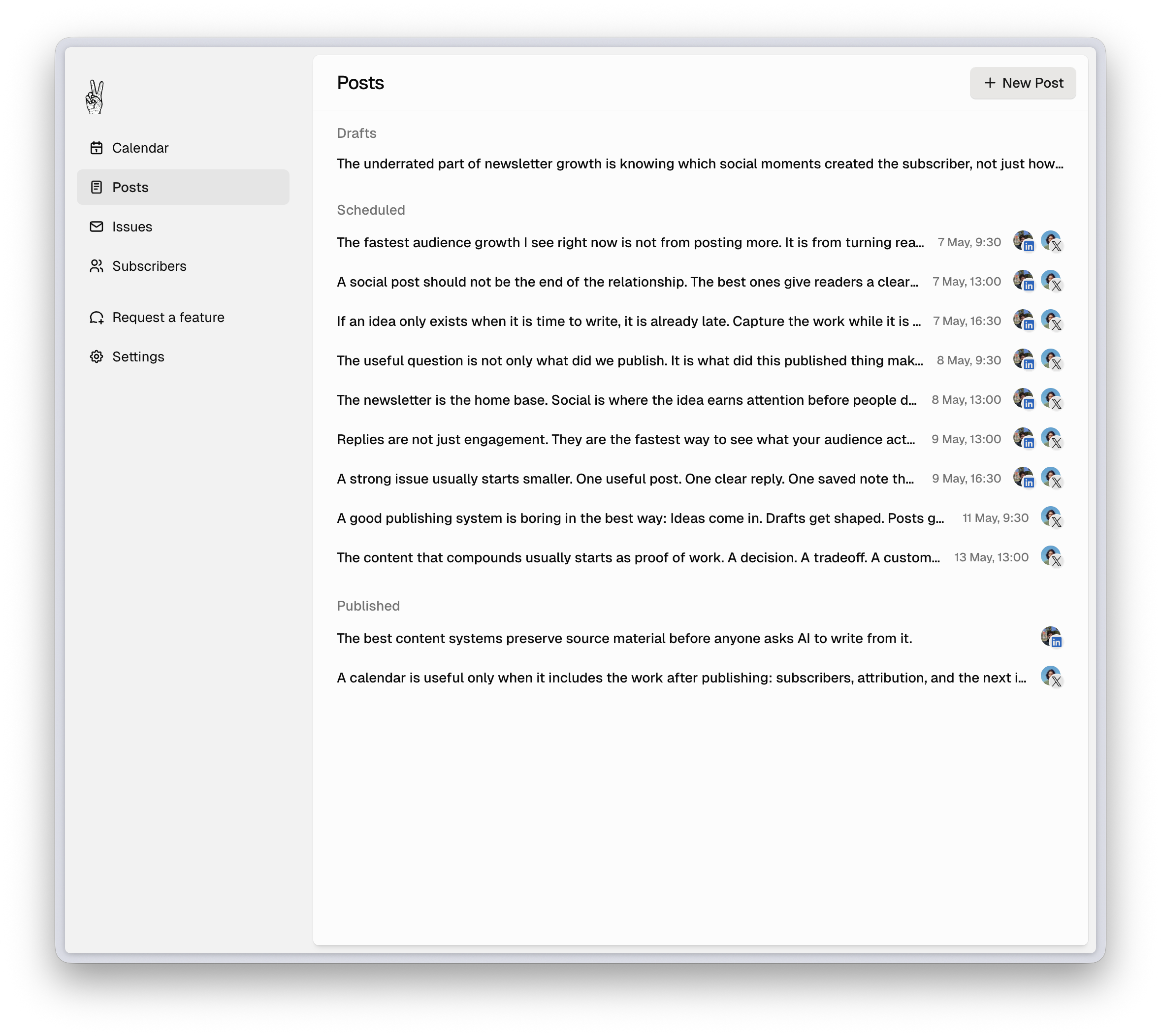
This matters for founders, creators, and small teams who already build attention on X and LinkedIn.
Likes, comments, and impressions are not the asset. The subscriber relationship is the asset. Maito's job is to connect the two.
API and MCP for agent workflows#
This is an important positioning difference, but it needs to stay concrete.
Other newsletter platforms can add AI features, MCP support, or agent integrations over time. beehiiv already lists API access and beehiiv MCP on its pricing page. The practical Maito angle is narrower: Maito exposes API and MCP surfaces so agents can work with drafts, issues, subscribers, archives, attribution, and the social posts that feed subscriber growth.
That matters if you want to use tools like Codex, Claude, or agent workspaces to help with newsletter operations, not just draft generic content. The useful surface is the actual publishing system: newsletter issues, categories, archives, subscriber data, attribution, segmentation, promotion workflows, and the API surface for custom builds.
Use Maito if you want the operator to stay in control, the newsletter to stay under your brand, and your social-to-subscriber workflow to connect to the tools you already use. Maito also provides prompts for coding agents, so a user can ask an AI coding tool to build a custom archive, landing page, subscribe flow, or internal workflow on top of the API.
Website, customization, and API#
beehiiv has strong website and publication tools. It is a good fit if you want a hosted newsletter site, custom domains, publication templates, and a growth-focused website layer inside the same platform.
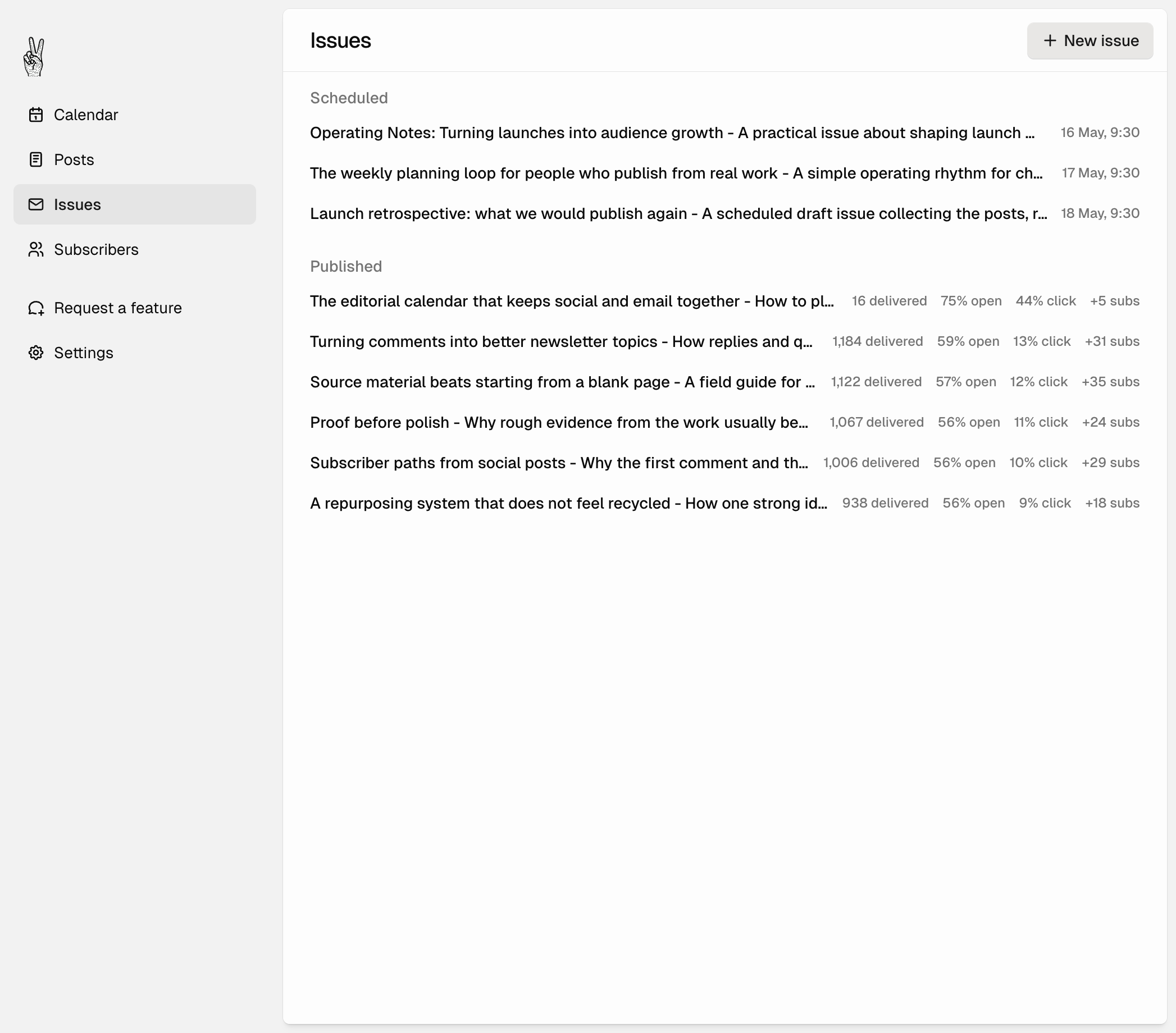
Maito also gives creators a hosted newsletter site, public archive, issue pages, subscribe paths, custom domains, and customization. The difference is how open the workflow is. Maito also includes widgets, API access, and MCP access so users can build custom sites, retrieve categories and archives, create custom subscribe experiences, and connect their own tools.
Choose beehiiv if you want more built-in newsletter business features.
Choose Maito if you want the newsletter website plus social publishing plus attribution, with room to build custom newsletter sites, archives, subscribe flows, and internal workflows on top of the API.
Pricing comparison#
beehiiv and Maito both have free starting points, but they price around different assumptions.
According to beehiiv's official pricing page, beehiiv's Launch plan is free up to 2,500 subscribers. At the 1,000-subscriber selector, the Scale plan was listed at $43/month billed annually and the Max plan at $96/month billed annually. beehiiv's FAQ also says paid plans start at $49/month. Paid plans unlock the growth and monetization features people usually associate with beehiiv.
Maito's pricing page lists a free Hobby plan up to 1,000 active subscribers. Hobby includes unlimited email sends, a newsletter website, subscribe forms, publish-now workflows, API access, and MCP access. Maito's Scale plan starts at $29/month for 2,500 active subscribers and adds scheduled newsletter issues, scheduled X posts, scheduled LinkedIn posts, auto newsletter links, source attribution analytics, and subscriber segmentation.
| Pricing question | beehiiv | Maito |
|---|---|---|
| Free plan | Launch, up to 2,500 subscribers | Hobby, up to 1,000 active subscribers |
| Paid starting point | Paid plans start at $49/month according to beehiiv's FAQ; annual Scale display showed $43/month at the checked setting | Scale starts at $29/month for 2,500 active subscribers |
| Email sends | Unlimited on all plans | Included; Maito does not charge by send volume |
| Paid subscription fee | beehiiv says it takes 0% of paid subscription revenue, excluding Stripe fees | Not the main monetization feature today |
| Best pricing fit | Teams that will use growth and monetization depth | Creators who need publishing, social scheduling, attribution, and segmentation without the full beehiiv suite |
The pricing decision is not only about which number is lower.
beehiiv is easier to justify when referrals, ads, Boosts, paid subscriptions, automations, and monetization are part of your near-term plan.
Maito is easier to justify when you mainly need to publish, promote on X/LinkedIn, track subscriber sources, and keep the workflow lightweight.
Real user feedback and switching triggers#
User feedback on beehiiv usually confirms the same pattern: people like its power, but some feel the weight.
Recent public examples:
- In a Reddit thread asking about people's experience with beehiiv, users praised referrals, flexibility, automations, segments, site customization, and list ownership. One user said the referral system was the best part because it could bring subscribers without much manual work.
- The same thread also shows the complexity tradeoff: a long-term user said beehiiv is powerful if you know what you want to do, but the number of options can feel overwhelming up front.
- In a May 2026 thread about the beehiiv website builder, a user asked whether beehiiv's site design would ever feel closer to Framer, Webflow, or Wix. That is the main customization caveat: beehiiv has website tools, but they will not fit every custom site workflow.
- In a thread asking whether beehiiv is overpriced, users debated whether Boosts and the Ad Network justify the cost for smaller newsletters. The useful takeaway is that monetization features are strongest when you already have the audience and operating model to use them.
Common switching triggers:
- small newsletters can feel the paid-feature jump before revenue catches up
- some users find the website builder, support, reliability, or complexity frustrating for their workflow
The decision is not whether beehiiv is good. It is good. The question is whether you need beehiiv's growth suite right now, or whether your real bottleneck is turning social reach into owned subscribers.
Best choice by persona#
| Persona | Better fit | Why |
|---|---|---|
| Solo writer starting from zero | Depends | beehiiv has the larger free subscriber allowance; Maito is better if X/LinkedIn are already part of the workflow |
| Founder building on LinkedIn | Maito | Native LinkedIn promotion, newsletter links, attribution, and segmentation fit the job |
| X creator turning threads into newsletter readers | Maito | The social-to-newsletter workflow is the core use case |
| Newsletter operator with referral strategy | beehiiv | Referrals, recommendations, Boosts, and monetization depth are stronger |
| Media-style newsletter business | beehiiv | More mature growth and monetization suite |
| Creator who wants a custom site on top of newsletter data | Maito | Hosted site plus widgets, API, and MCP access create a more open workflow |
| Team with multiple publications and ad monetization | beehiiv | More mature operator features and monetization surfaces |
Final verdict#
beehiiv is the better choice if you want a mature newsletter growth platform. It has more depth for referrals, recommendations, ads, Boosts, automations, paid subscriptions, and newsletter-business operations.
Maito is the better choice if your growth loop starts on X or LinkedIn and you want the newsletter to be open to the tools you already use. It keeps the newsletter as the owned home base, gives you native social publishing, connects posts back to subscriber growth, and gives API/MCP surfaces for AI-ready customization.
Choose beehiiv if you need the full newsletter growth and monetization suite.
Choose Maito if you want a human-first, AI-ready social-to-newsletter growth suite built around publishing issues, promoting them through X and LinkedIn, and turning rented reach into owned subscribers.
FAQ#
Is Maito a beehiiv alternative?#
Yes, Maito can be a beehiiv alternative if your main goal is publishing a newsletter and growing it through X and LinkedIn. beehiiv is stronger for referrals, ads, Boosts, and monetization depth. Maito is stronger for native social publishing, subscriber attribution from posts, and a lighter newsletter home base.
Which is better for newsletter growth, beehiiv or Maito?#
beehiiv is better for newsletter growth if you want referrals, recommendations, Boosts, ads, automations, and mature monetization tools. Maito is better if your newsletter growth comes from X and LinkedIn and you want to attribute subscribers back to specific social posts.
Which is better for X and LinkedIn promotion?#
Maito is better for X and LinkedIn promotion because native X and LinkedIn editors, previews, scheduling, newsletter links, and post-level subscriber attribution are central to the workflow.
Which is better for monetization?#
beehiiv is better for built-in monetization. It has paid subscriptions, the Ad Network, Boosts, direct sponsorship tools, and digital products. Maito is currently stronger for audience ownership, publishing, social promotion, attribution, and segmentation.
Which is better for owning your audience?#
Both products support owned newsletter audiences and subscriber export. Maito is more focused on turning social attention into owned subscribers and keeping the publishing system open through hosted sites, custom domains, widgets, API, and MCP access for custom builds.
Which is better for AI-assisted newsletter operations?#
Maito is the better fit if you want AI tools or agent workspaces to operate around the newsletter system through API and MCP access, or if you want prompts that help coding agents build custom experiences on top of your newsletter data. beehiiv may add more AI or integration support over time, but Maito's position is more directly tied to social-to-subscriber attribution and open newsletter operations.
Should I read the beehiiv review before comparing?#
If you want a deeper look at beehiiv's pricing, editor, growth tools, pros, cons, and user feedback, read the full beehiiv review. This page is for the direct beehiiv vs Maito decision.